ENVIRONMENTAL COMMITTEE
Harry Baum-Committee Chairperson,
Alfred Esser, Ray Stockwell, Neil Brown
There is an environmental and
information table at City Hall in
the main entry area.  It's stocked
with helpful pamphlets and
brochures offering The Weatherby
Lake Improvement Company has
ideas on how to keep our lake
beautiful.  Feel free to take what
you need!
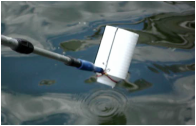
A WINDY TRIP ON THE WATER WITH THE ENVIRONMENTAL TEAM FOR WATER
QUALITY TESTING.
RAIN EVENT OF SEPTEMBER 23, 2005
HERE IT COMES!!!
This photograph is taken across the box culvert of the above picture looking west next to the bean field.  It shows the velocity of
water flowing through Rush Creek and entering at North Cove.
This is stormwater runoff at the "hair-pin curve on Westside Drive (O-Cove
Access Area)
This photo is taken from the walking bridge at O-Cove facing east.
This photograph was taken on Amity Road looking east at Rush Creek next to
Amity Nature Park.  This is what is coming down through the Rush Creek
watershed.  Notice the height that the water reached by the grass laying flat.
Barry Road Bridge at Rush Creek showing the stormwater runoff entering our lake.
This photograph is taken next to the walking bridge on Barry Road.  Picture was
taken from the seawall facing west showing the seawall facing west showing the
debris, siltation and stormwater runoff entering North Cove and flowing down
into the main body of the lake.
Photograph taken between the walking bridge an street bridge on Barry Road.  
Again, notice the amount of debris & trash entering our lake.  Non-point
source pollution.
This is Rush Creek on the west side of Congress.  These are the 60" outlet
pipes that are receiving the stormwater run off from Zona Rosa, Congress
(South to Barry & North to Tiffany Springs, including stormwater run off
from the apartment complexes on the north side of Highway 152 and next to
Congress Ave. and continuing to the closed Ramada Inn.
Additional shot of North Cove debris from this storm.
Additional shot of the O-Cove pipes taken at approximately 12:30 pm after
rain had stopped.
RUSH CREEK PHOTOS APRIL 11, 2005
Click on the links to see the impact of this rainstorm on our lake.
WEATHERBY LAKE IMPROVEMENT COMPANY RECOMMENDATIONS FOR A GREEN LAWN AND CLEAN LAKE

DON'T - use high phosphate formulas like 0-46-0    18-24-12    8-32-16    10-20-10    10-34-3

DON'T - use garden fertilizer formulas like 10-10-10   12-12-12    13-13-13

DON'T - spread fertilizer into the lake, on driveways or streets!

DON'T - wash cars, boats, rv's or decks with soap containing phosphate!

DO - use slow release fertilizer formulas!

DO - use natural organic products!

DO - use higher nitrogen, low phosphate formulas like 30-5-5    30-4-6    29-3-5

DO - spread fertilizer only on lawn surface!

DO - use grass seed varieties with natural dark green color such as Rugby II    Accent    Opal    Imagine


It's up to all of us to keep our lake clean and unpolluted!
             WEATHERBY LAKE IMPROVEMENT COMPANY

                   BOAT OWNER'S/VISITORS AGREEMENT

The possible invasion of Zebra mussels into Weatherby Lake is of great concern. They can totally destroy the aquatic life in a lake.
There are only two ways for the mussels to infest the lake.

(1.) In the water flow from the Weatherby Lake watershed.

(2.) Attached to boats and equipment that has been in "foreign" waters.

The following cleaning and inspection procedures were established by the Missouri Department of Conservation and have been
adapted by the Weatherby Lake Improvement Company. The cleaning and inspection procedure is applicable to visiting boats and
WLIC boat owners that transport their boat to "foreign" water. "Foreign" water is ANY water outside Weatherby Lake.

PRIOR TO LAUNCHING/CLEANING AND INSPECTION FOR ANY BOAT THAT HAS BEEN IN "FOREIGN" WATER.
(Cleaning and inspection guideline per State of Missouri.)

Drain all bilges, live wells, bail buckets, and engine compartments BEFORE returning to the Weatherby Lake watershed.

BEFORE returning to the Weatherby Lake watershed, high pressure wash all parts of the boat, motor, boat trailer and equipment
that has been in contact with water.

AFTER cleaning and BEFORE returning to Weatherby Lake, inspect all parts of the boat and trailer. Small zebra mussels are the
size of a grain of sand. If the boat hull feels rough when it should feel smooth, zebra mussels may be attached. If there is any
question about whether or not zebra mussels are attached to your boat, trailer or equipment, contact the Missouri Conservation
Department. DO NOT launch your boat in Weatherby Lake UNTIL it has been inspected by a Conservation Agent or other qualified
person to determine if zebra mussels are attached.

After returning home, disinfect bilges, live wells, anchors, bait buckets, lines, motor, trailer and boat hull. Disinfect with either 1/2
cup of salt per gallon or hot water, or 2 tablespoons of chlorine beach per gallon of hot water.

Let the boat, trailer and all equipment air dry for a minimum of 5 days before re-entering Weatherby Lake.

DO NOT transfer any aquatic plants, animals or bottom material from one river, stream or lake to another.

Even though most boats never leave Weatherby Lake, all boat owners are required to sign this agreement BEFORE boat and motor
stickers are issued for the current year.

I have read and agree to abide by the above cleaning and inspection procedures. I understand that failure to follow the cleaning and
inspection procedures may result in loss of lake privileges.


Signed___________________________ Date________________________


Block/Lot_____________ or Address___________________________________

(If in a Yacht Club Regatta)
      CARING FOR WEATHERBY LAKE BY ARMAND MATTHEWS

The state & Future of our lake

Lake management is a constant balancing act. Too few nutrients, a lake can be sterile and lifeless. Too many nutrients, biological
activity is excessive, resulting in extreme conditions such as algae bloom, excessive weed growth and fish kills. Toxic
contaminants will also render a lake lifeless and unfit for use. The ideal lake is ecologically balanced, has a diversified food chain
ranging from tiny algae to fish and is free of contaminants.
The University of Missouri conducted a six-month, twice-a-week sampling program of 13 Missouri lakes in 1994. Weatherby Lake
was one of the lakes studied. The study ranks Weatherby Lake as one of the best lakes in northern Missouri. Weatherby Lake
compares favorably with the southwest Missouri lakes that get most of their water run off from rocky soils that do not contribute
much silt.

Weatherby Lake residents can be proud of the water quality. The study shows a good balance of nutrients for aquatic life and fish.
While the study did not test for hazardous substances there is no current reason for concern. Now is not the time to become
complacent and let our guard down. The need to prevent contamination by hazardous substances increases in inverse relation to the
need to limit construction erosion. We must address and control contaminants NOW, for it is easier to prevent pollution than to
remove it.

Hazardous contamination is ANYTHING that is detrimental to aquatic life, fish and water quality. Water run off and mud (eroded
soil) contains hazardous substances entrapped in soil particles, such as fertilizers, herbicides, pesticides, insecticides, and
hydrocarbons. These contaminants come from developed areas such as yards, driveways and streets that drain into the lake via the
storm water system.

THE PROBLEM

Most homeowners want a green, weed and pest free lawn that will improve the appearance and value of their property. But we
create a problem for our lake and ourselves if we obtain a lush green lawn through indiscriminate and excessive application of
pesticides, herbicides and fertilizers. Plants use only 60% of commercial nitrogen fertilizer. Some modern herbicides will last for 50
years! Every time any of these products is misused or over applied they contribute hazardous contamination to the lake.

THE SOLUTION IS SIMPLE

Always follow label directions.  Know what, when and how much to apply. Use the correct products and use them correctly. Use
only what is needed.

Don't apply any fertilizer or chemical just because you think you might need it. If you don't know, take soil samples from at least
four places in the yard and send a blended sample to the Extension Service for analysis. Apply fertilizer according to soil test
recommendations. The phosphorus content of fertilizer should not be more than 3% unless a soil test shows a phosphorus
deficiency. The middle number of a chemical analysis is the phosphorus. Example 28-3-3 contains 28% nitrogen and 3%
phosphorus and potash.

Organic fertilizer is preferred. Organic fertilizer made with such products as bone meal, feather meal, and vegetable source fly ash
are contaminant free, 100% available, and slow release. These fertilizers provide many trace elements not found in typical NPK
fertilizers.

DO NOT OVER FERTILIZE! Most lawns only need about 2 pounds of nitrogen per year. Apply half in the fall and the remaining
half in early spring. If there is an isolated weed or pest problem, SPOT TREAT rather than treating the entire yard.


THE NATURAL APPROACH

The best overall solution is to increase the organic(humic) content of the soil. Organic matter, containing humic substances
increase soil fertility, improves plant health and nutrition and helps clean the soil. A healthy plant produces its own defense systems
to fight off pests, fungi and other predators. Weeds have more trouble growing in a healthy turf. NPK alone will not improve soil
fertility.

Although herbicides and pesticides are designed to be selective in treatment, they still destroy some beneficial animals and
organisms which are vital part of a healthy soil. For these reasons, maintaining adequate organic(humic matter) is very important.

Nature provides one of the best environmental systems yet devised. for millions of years, ground water has been cleaned and
decontaminated by humic substances in soil.

There are two ways to add humic substances to the soil. One way is compost, an excellent source of organic matter. The other
method is highly concentrated naturally occurring humic products that can be added to dry fertilizer or in a convenient sprayable
liquid.

COMPOST, NATURE'S EROSION & POLLUTION CONTROL

Compost has been used, in Europe, to remove and destroy toxic organics for many years. Compost is:
virtually maintenance free once applied.

effective for as long as three years.

an excellent soil amendment.

filters and slows the flow of water. Silt will fall out if the flow rate is reduced before it reaches streams and lakes.

can hold up to 20 times its weight in water.

a 3-inch layer enables workers and machines to work in areas and on slopes previously inaccessible because of mud.

If digging is necessary, the compost is scraped away and redistributed after completion.

more effective than hydro-seeding and silt fences.

able to bind and remove contaminants from water. Humic substances in compost can decompose many compounds through
bioremediation.

WHY USE HUMIC SUBSTANCES?

The usage rate for herbicides and pesticides can be reduced to the lowest recommended rate with the addition of small quantities of
humic acids. Humic acid:

increases fertilize utilization. Less fertilizer is needed to maintain the same results.

increases plant resistance to disease and insects.

improves soil water holding capacity.

improves seed germination and root growth.

increases soil humic content and beneficial microbial activity.

supplies many trace elements necessary for good plant nutrition.

helps bind and decompose many toxic substances.

NEW PRODUCTS

New natural environmentally friendly products are being developed. Some are available now and others will be available very soon.
Environmentally safe products are the fastest growing segment of the lawn care market and have tripled their market share in the
last ten years.  Some new products will help the lake and should be used by home owners and lawn care companies.

Corn gluten meal (CGM): Iowa State University discovered that CGM, a residue from wet corn milling, is a good pre emergent that
controls crab grass. Besides being a good pre emergent, it contains about 10% nitrogen in a natural slow release form.

Dry organic and chemical fertilizers that contain a source of humic matter generally from oxidized lignite. The benefits from use of
humic matter have been described above.

Organic fertilizers made from animal and plant by-products that contain humic matter as an added ingredient.

Liquid humid matter (liquid organics) is a versatile sprayable product that can be sprayed alone or in combination with liquid
fertilizer and most herbicides and pesticides. Benefits have been described above. One gallon of quality product containing 10%
humic matter will treat 15,000 sq. ft. three times. This is a year's supply for most lawns.

Insist anytime you purchase of have any lawn care products applied, that products are environmentally friendly and proven to NOT
HARM OUR LAKE!
RECYCLING IN THE NORTHLAND

Used Motor Oil:
Advance Auto Parts - 403 NW Barry Rd

Scrap metal:
Brewer's Metals - Antioch Shopping Center (northeast corner of parking lot), (816) 517-7067
North Kansas City Iron & Metal - 1222 Iron, North Kansas City, MO, (816) 471-3244

Appliances working and non-working:
Visit the
MARC site.

Computers & Peripherals:
The Surplus Exchange - 1107 Hickory - 813-472-0444
(also takes telephones, stereos & copiers-they do charge for some items)
Bicycles & Tricycles:
Bikes & Trikes for Tykes 913-371-6551 Main drop off Blue Ridge Mall and others around city-ask about pickup

Newspapers, office paper, magazines, telephone books:
Weatherby Lake City Hall parking lot-NW Corner

Aluminum Cans, Tin Cans, Plastic Bottles (#1 & #2 only), Glass (food & beverage only), Office Paper, Newspaper, Cardboard,
Magazines Paperboard, Telephone Books, Foil and Pie Pans, Scrap Metal, Clothing and Small Household Items, Household
Batteries, Toner and Inkjet Cartridges:
Community Recycling Center - Metro North Mall-far north lot- 816-561-1090
Hours: Wed - Fri 11am - 5:30pm, Sat 8am - 4pm

MARC Drop-off program
Building materials (also have materials for sale):
Habitat ReStore 4701 Deramus (Near Front Street & Choteau) Kansas City, MO 64120
816-231-6889

Household Hazardous Waste (HHW):
MARC HHW Site 4707 Deramus, KC, MO 816-784-2080 Appointment Required
June 3, 2000 Water Shed Tour
At Westside Drive and Roberts Road
Fish and Wild Life Reports

Leave it to Beavers

Beavers are present on the lake.  Protect your trees and property from beaver damage.  The key to living with beavers is
appreciating the important role they play in establishing and maintaining wetlands, which in turn provide critical environmental
functions. The beaver's handiwork can have far-reaching positive effects. Beaver impoundments provide rich habitat for a great
variety of species, including plants, waterfowl, songbirds, amphibians, fish, insects, and mammals. Dams may also improve water
quality by acting as a settling basin, and provide excellent flood control by slowing water movement. If we protect our trees at
Weatherby Lake, it lets beaver have their say in the balance of  nature.

Tree Protection

If your wooded property is adjacent to an area populated by beavers or located near water, your aquatic neighbors will likely pay a
visit in the autumn and early spring. This may not be a problem for many people. But if you have small ornamental or valuable
specimen trees that need protection from beavers, tree guards are an effective solution.
You can wrap small trees with simple cylinders of galvanized, welded wire, placed 6–12 inches out from the trunk and standing
about three feet high. Chicken wire or hardware cloth (1/4- to 1/2-inch mesh) will also work, but the heavier galvanized wire will
hold up better. Cylinders on larger trees may require staking, and mulching within the cylinders will prevent weed growth. For
seedling trees, corrugated plastic drainpipes provide low-cost, easy-to-install protection. Just slit the pipes to allow room for
growth, then place them around the trees.

Since beavers are not good climbers, a three- to four-foot fence can also be a permanent deterrent. This may be the best option
when trees that need protection are grouped together. Try fencing off just the water side first, and then extend the fence if the
beavers start to find their way around it.

We all need to take responsibility for protecting our trees and property from beaver damage.  To protect trees from beaver cutting,
the trunks should be enclosed in wire netting up to a height of three feet (.9 m).  Beavers prefer soft wood such as Birch, Pear,
Willow, etc. Protect your valuable trees before the beavers in our lake have them for lunch.  However, if you see beaver damage in
WLIC access areas, please call WLIC Fish and Wildlife Committee Chair, Bonnie VanCleave at 741-0751.  If needed the WLIC may
chose to set a live Hancock  trap at a cost of $189 for trap set up and $100 per trapped beaver. The Hancock trap will capture the
beaver or any other animal alive until a Wildlife Technician arrives to removed the trapped animal.


Goose Management Program for Weatherby Lake 2005

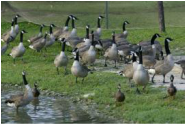
Geese are present on the lake and properties throughout the year.  Their population typically peaks in the fall and winter when the
resident gees actually act as decoys to draw migrating gees onto the property.  The fecal matter that geese generate is quite
significant. This year the lake was closed to swimming for one weekend in August due to the high level of e-coli contamination
from geese fecal matter.  Geese eat approximately 2-4 lbs. of grass a day and expel 1-2 lbs. per day.  These dropping contain
various parasites that are not only detrimental the environment, but also cause illness to individuals through both direct and indirect
contact.  The fecal material alson contains undigested seed of various plants and weed of weeds growing in the area where the
matter is deposited.  If geese nest on the property the adults can become very aggressive in protecting the nesting area or young
goslings. Additionally the potential of elevated Coloform levels can lead to water problems in the lake.

Management of the population of geese at Weatherby Lake recommends an integrated Goose Management Program. Using this
integrated system, we not only significantly reduce the population of resident geese, but keep migratory gees from making the
property their temporary home.

During the spring if geese attempt to nest on your property please call the WLIC office or Bonnie VanCleave. A Wildlife Technician
will addle or oil the eggs to stop the embryo development. All attempts will be made to locate all nests.  In the off chance that some
geese are still utilizing the property during the molting period, a goose round up will be considered.  As the birds are unable to fly
during the molt, the geese will be removed and taken to a designated facility for processing.

We understand that a majority of the property that border the lake is cared for by individual residents. The WLIC can provide
individual residents with  the name of an approved company that can work with the property owner to tailor a Flight Control
application program to fit their individual needs.  A non-toxic, biodegradable, repellent; Flight Control uses the UV light spectrum
which is unnoticeable to the human eye, but makes the grass appear un-palatable to the geese.  This service will be the
responsibility of the property owner and be an estimated per case fee.
Counter
ENVIRONMENTAL / FISHERIES / WILDLIFE
WEATHERBY LAKE IMPROVEMENT COMPANY
ALGAE INFORMATION
                                                             Love the Lake  

This is the first of a monthly educational series on how you can personally impact the quality of Weatherby Lake.  This is simple
stuff.  Rake your leaves so they don’t fall into the lake, keep grass clipping out of the streets, use slow release nitrogen fertilizer
and most importantly, please take ACTION.

Yes, your help and love is needed.  As a community we all need to engage, get involved, and take simple, yet effective actions to
save the quality of Weatherby Lake water.  

Thank you in advance for helping us Love the Lake
and the community we call home!

Weatherby Lake Stream Team,
Bonnie VanCleave
Kaila Schmidt

Did you know?
•        Leaves falling into the lake and collecting in the coves can provide a nutrient source for algae growth.  When algae grows in
the lake it can deplete oxygen in the water which can cause fish kills.  In addition, it can in rare cases cause skin irritation when
swimming for both humans and pets.
•        Leaves and grass clipping collecting in the streets can find there way into the lake.  They get carried away by the storm
drains that ultimately empty into Weatherby Lake.
•        Fertilizers when applied incorrectly can provide nutrients which promote the growth of algae and aquatic weeds in the lake
degrading water quality.

How can you help?
•        Residents rake your yard leaves into bags this fall so they don’t inadvertently fall into the lake.
•        Dispose of your grass clipping and other yard waste in bags this season versus blowing them into the street and/or lake.
•        Purchase slow release nitrogen fertilizer for a healthy lawn and read and follow manufacturer’s recommendations and
directions for use.
•        Volunteer to help on Saturday, November 3rd for a Cove Clean Up.  We will be meeting at city hall at 10 a.m. and assigning
coves that still need leaves to be raked up into bags, trash removal and general maintenance.  Total time commitment is 2 hours.  
All you need to bring with you are trash bags, a rake and a good attitude.  Contact Bob Meyer at WLIC 816-741-5556, Bonnie
VanCleave at 816-741-0751 or Kaila Schmidt at 816-587-7534 with questions.

Zebra mussels and a related species, quagga mussels, are fingernail-sized black-and-white striped bivalve mollusks native to
the Caspian Sea region of Asia.

Next Generation – Plants and Animals

They came to North American waters in international shipping ballast water and were discovered in Lake St. Clair near
Detroit in 1988. Since then, zebra mussels have spread rapidly throughout the Great Lakes and connected waterways of the
Mississippi River, including the Arkansas, Illinois, Ohio and Tennessee rivers.
Zebra mussels were first reported in Missouri in 1991 in the Mississippi River. For eight years, they were not found west of
the Mississippi in our state. In spring 1999, however, zebra mussels were reported in the Missouri River near Sioux City,
Iowa. In August 1999, zebra mussels were found in the lower Meramec River, a Mississippi River tributary south of St.
Louis.

It's suspected that commercial barges originating from the Mississippi River, transported attached adult zebra mussels
upstream to these previously un-infested areas. During the next several decades, zebra mussels could spread to other
freshwater locations in Missouri and throughout North America.

Female zebra mussels can produce as many as 1 million eggs per year. These develop into microscopic free-swimming
larvae (veligers) that quickly begin to form shells. At about three weeks, the sand-grain-sized larvae start to settle, and by
suing they byssal threads, attach to any firm surface. They clump together and cover rock, metal, rubber, wood, docks, boat
hulls, native mussels, crayfish and even aquatic plants.

Zebra mussels filter plankton from the surrounding water. Each mussel can filter about one quart of water per day. However,
not all of what they remove is eaten.

What they don't eat is combined with mucus as "pseudo-feces" and discharged onto the lake bottom where it accumulates.
This material, which may benefit bottom feeders, also may reduce the plankton food chain for upper water species. Diving
ducks, the freshwater drum and other fish eat zebra mussels, but will not control them.

Pam Cline prevented an infestation of Lake of the Ozarks by alerting MDC fisheries biologists when she found zebra
mussels clogging this boat propeller at Glencove Marina.

Zebra mussels can clog power plants, industrial and public drinking water intakes, foul boat hulls, decimate populations of
native freshwater mussels, impact fisheries and disrupt aquatic ecosystems. Economic impacts of zebra mussels in North
America during the next decade are expected to be in the billions of dollars.

Overland transport on boats, motors, trailers and aquatic plants poses one of the greatest risk for spreading zebra mussels.
Larger adult zebra mussels can live several days out of water in moist, shaded areas.

Boats that have been moored or stored for more than just a day or two in zebra mussel-infested waters may carry
"hitchhiking" mussels attached to their hulls, engine drive units and anchor chains. Boats that have been in infested waters for
only a day or two are less likely to transport adult zebra mussels.

Microscopic zebra mussel velgers can survive in boat bilge water, livewells, bait buckets and engine cooling water systems,
regardless of how long the boat has been in infested waters.  However, they will die very quickly when their hiding places
are warmed in the sun or when they "blow dry" on the highway on the trip home.

How You Can Help Prevent Their Spread

If you are a water recreationist (boater, angler, water-skier, scuba-diver, sailor or canoeist) there are some important things
you can do to prevent the transport of zebra mussels and other harmful exotic species from one lake or river to another. In
some states and provinces it is illegal to transport harmful exotic species.

To prevent the spread of zebra mussels throughout Missouri and North America - and to keep your own equipment from
being fouled - please observe the following "clean boating" suggestions when transporting your boat from waterway to
waterway.

Inspect

Thoroughly inspect your boat's hull, drive unit, trim plates, trolling plates, prop guards, transducers, centerboards, rollers,
axles, anchor, anchor rope and trailer. Scrape of and trash any suspected mussels, however small. Remove all water weeds
hanging from the boat or trailer before leaving any water body.

Drain

Drain water from the motor, livewell, bilge and transom wells and any other water from your boat and equipment while on
land before leaving any water body.

Dump

Trash leftover bait on land, away from water, before leaving any water body. Leftover live aquatic bait that has contacted
infested waters should not be taken to uninfested waters.

Rinse

When you get home - before launching your boat into uninfested waters - thoroughly rinse and dry the hull, drive unit,
livewells (and livewell pumping system), bilge, trailer, bait buckets, engine cooling system and other boat parts that got wet
while in infested waters; use a hard spray from a garden hose.

If your boat was in infested waters for a long period of time, or if you find any attached adult mussels, use HOT (104 F)
water instead of cold, or tow the boat through a do-it-yourself carwash and use the high pressure hot water to "de-mussel"
your boat. Do not use chlorine bleach or other environmentally unsound washing solutions.

Dry

Boats, motors and trailers should be allowed to dry thoroughly in the sun for at least five days before boating again.

In the Slip

In infested waters, the best way to keep a hull mussel-free is to run the boat frequently (small juvenile mussels are quite soft
and are scoured off the hull at high speeds).

On boats which remain in the water, zebra mussels can attach to drive units, cover or enter water intakes, and clog, overheat
and destroy the engine.

If possible, leave outboards or outdrives in the up position. Periodically inspect hulls and drive units, and scrape free of
mussels. Pump hot water through your engine's intake on a regular basis to prevent mussel growth inside the engine's cooling
system.

Identify the Enemy

Learn what these organisms look like (at least those you can see). If you suspect a new infestation of an exotic plant or
animal, report it to your natural resource agency.

Consult the agency for recommendations and permits before you try to control or eradicate an exotic "pest."
Remember, exotic "pest" species thrive on disturbance. Do-it-yourself control treatments often make matters worse and can
harm native species.

Where to Look for Zebra Mussels

•        Boats
•        Bait bucket
•        Recreational watercraft
•        Sailboats

To report a potential zebra mussel sighting or for additional information, contact your nearest Missouri Conservation
Department Office or:

Missouri Department of Conservation, 1110 S. College Ave., Columbia, Missouri 65201, Phone: 573-882-9880
Several Missouri Stream Teams already are helping by monitoring streams for zebra mussels. If you would like to join the
effort, call (800) 781-1989 or visit the Stream Team web-site at www.mostreamteam.org.
From the Missouri Department of Conservation Website
ZEBRA MUSSELS
KANSAS CITY STAR - ZEBRA MUSSELS